
Roberto Savio — A personal recollection
I had the honour of working with President Moro in the days of my youth. He was an extraordinary teacher, because he listened to his collaborators and explained to them when they were wrong. When I see the difference with the men in power today, I realise that the world has lost dialogue, tolerance and democracy.
I would like to recall two lessons.
Once, while I was insisting on publishing an article of mine that was very critical of the slow pace of the decolonisation process, he pointed out to me that Il Popolo was, in a way, the voice of the government, and that this would create friction with the European countries involved. When I remarked that we were thereby missing an opportunity to declare ourselves different, he said to me: “Savio, more than the opposite one cannot do. And this is done through politics, not through articles, which can easily be used to open up another controversy. Politics is made with facts, not with polemics.”
On another occasion, when I observed that we were too closely aligned with positions of the United States that had nothing to do with Italy’s interests, he told me: “Savio, there is a difference between a prophet and a politician. The prophet has the duty to shout the truth. The politician has the duty to bring it about. In Washington they already consider me too independent. The truth must be realised together with the citizens. And in this country many are pro-Atlantic out of inertia. We have to pursue our own policy, but without breaking with the United States, because the balance of power does not allow it.”
When Moro was murdered, these words came back to me with great force…
Years later, Boutros Boutros-Ghali — another person who taught me that battles should be fought only if one is sure of winning them — told me: “The Americans do not want you to say yes. They want you to say yes sir.” And he is the only Secretary-General to have served only one term, precisely because he did not say yes sir… Today silence is the only weapon. To say nothing.
Roberto Savio, President of Other News
Moro, a human and political journey to be probed and passed on
The assassination of the Christian Democrat statesman is Italy’s Berlin Wall, ten years before the fall of the real Wall. He was thinking of a movement not only of rapprochement between different forces, but also of the search for a rule of coexistence, not the affirmation of an integral political system.
by Gilberto Bonalumi
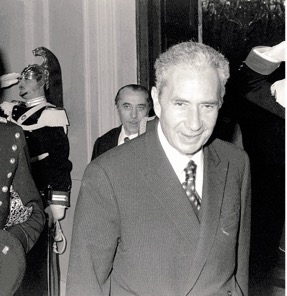
Aldo Moro at the Quirinal Palace, 1976.
Do we still need some refresher in political history capable of illuminating the present? It is held that the world has changed so profoundly that even what was significant in not-so-distant times has been rendered so insignificant as to appear incomparable. Now that history seems to be back in fashion, when certain events are brought up again, attention must be paid to whether this is done to pass on knowledge of the past or to spread interpretations born of research but also of vested readings.
The question arises once more whether the meaning of Aldo Moro’s human and political journey — the man who was the linchpin of the Constituent Assembly — should be confined to the level of historical reconstruction, or whether it can still have something to say in the particular civic climate of our country. Moro’s path was a biographical course that came to an abrupt and dramatic halt on 9 May 1978; and with it his overall political project was also interrupted.
Everything has been written on the Moro case, and the documentation — between judicial files and parliamentary inquiries — is voluminous; yet there is always a need to return to it, through memories, declassified documents and maps of the places of his captivity.
The need to return to the case, through memories and declassified documents: three recent essays.
The underground dialogue
This is the case with three recent publications: Mi sento abbandonato (“I feel abandoned”), which goes deeper into the negotiation to save Moro, edited by Claudio Martelli; Il disegno (“The Design”) by Federico Zatti, which investigates the escape of the Red Brigades members after the Via Fani attack; and L’Italia e il lodo Moro (“Italy and the Moro accord”) by Giacomo Pacini, which delves into that underground dialogue with the Palestinian movements, and the trust placed in their ability to talk to the Red Brigades in order to ensure Moro’s survival.
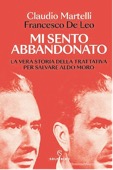
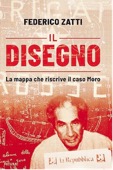
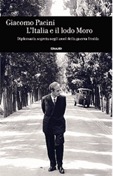
The three recent essays mentioned in the article: “Mi sento abbandonato” by Claudio Martelli and Francesco De Leo, “Il disegno” by Federico Zatti, “L’Italia e il lodo Moro” by Giacomo Pacini.
From Walter Veltroni’s introduction to Il caso Moro e la prima Repubblica (“The Moro Case and the First Republic”), one asks whether everything was done to save him — to release him, as Marco Bellocchio dreamed in Buongiorno notte, from that prison in Via Montalcini. To return him to his family, to politics, to the country? Or did the conviction prevail that a living Moro was a problem for everyone, no one excluded? Corrado Guerzoni, one of his closest collaborators, uttered these words: no one had any interest in finding the Hon. Moro; the president of the DC was wanted dead by this side too, because better that one man should die and nothing change, than that this man should live and everything have to change. Moro’s death is Italy’s Berlin Wall, ten years before the fall of the real Berlin Wall. Why not read Moro’s letters as those of a prisoner — lucid even if desperate — on statements clearly attributable to him and inadmissible if traced back to the BR?
Martelli puts forward an expression such as “Engage dialectically with Moro” — to better understand his letters and the possible paths of a humanitarian route to which Amintore Fanfani also committed himself, as his diary attests, recording his thinking in the debate inside the Christian Democracy.
The line of firmness
In those 55 days, the line of firmness was also on the table, tied to doubts about the capacity of the institutions to hold up. But the real scandal is that we did not manage to find Moro’s prison — which was not at the ends of the earth: it all took place in the city of Rome, where incompetence and deviance emerged, such as the failure to reach the hideout in Via Gradoli, the pointless dredging of Lake Duchessa, and a number of unsuitable advisers at the Ministry of the Interior. That this incompetence was then in some way “helped” by those who were against Moro’s politics and his role on the international stage is by no means to be ruled out.
How was it possible that contemptible individuals — intellectually speaking — were able to ride such an untameable and ferocious tiger that, from the confessions of the murderers themselves, it is even described as a form of constraint? An ambiguous terrorism, from beginning to end, for this very reason. The tragedy lies in those words of Moretti, when he says that he and his accomplices were “forced” to kill Moro. They do so by trying to construct a political “constraint” — declared by themselves at the time in a wholly autonomous and deliberately exaggerated manner, because it was entrusted to memoirs that must always be carefully read as defensive, without facile indulgence or understanding. To call it a revolutionary constraint is only the effort by which one would push outside one’s own conscience the criminal act — to be called inhuman, also considering the practice of torture exercised through the technique of the cramped prison. But if the decision is external, by implication, one is inevitably led to wonder who really exercised the constraint that brought irreparable grief to his family and to the families of his escort, that wounded the moral conscience of almost all Italians (striking society, not the State). In the end a policy was also struck dead, in a way wholly different from what was declared in the childish vindications-elucubrations about the imperialist State of the multinationals and its misdeeds — alive only in the imagination of the dregs of a rebelliousness loaded with ideological hatred. A difficult — perhaps even inapplicable — policy was hit. So inapplicable that Moro himself never wanted to spell it out in detail, and left it open to many interpretations. And here we soon come to the point, because in Moro a project was being struck. Of Moro it was said: the facts are his words, because in him the intelligence of events is always at play — our history being an unbroken sequence of states of necessity that put at risk the fullness of ideals and politics, weighing what can be gained and what must not be lost.
The terrorists gave a powerful push to the right of the Italian political axis.
The interpretative key
In effect, it should be said at once, as an interpretative key — one not declared as such but which emerges from the reading — that in the end the terrorists gave a powerful push to the right of the Italian political axis. By degrees this shift led the right (including the strand descending from the Fascist legacy) to government. Perhaps few had grasped the also juridical-procedural character of Moro’s attitude in proposing national unity, which was not a variant of compromise but something else. Procedural, because in the form of examination, of analysis, the legitimacy of the political fact it sought to produce was itself to be founded. Moro was not thinking of a compromise. His culture would never have led him to indulge even in a language that seemed tied to a kind of sale-and-purchase contract — the kind that begins, precisely, with a compromise. Of course, in common usage “compromise” meant perhaps only an understanding halfway between two distant parties. But Moro in this sense had seen the worst, and had grasped that the various proposals on the field were still those of an old foundation of parties that presented themselves as accomplished (relatively closed) political environments, in which the stark alternative of party or historical current had always left little room for a desirable alternation. Here, Moro was thinking of a movement not only of rapprochement between different forces, but also of the search for a rule of coexistence that should not result in the affirmation of an integral (and unilateral) political system of a single party heralding a regime in its underlying cultural design.
Moro had understood that to propose a wholly liberal, wholly socialist or wholly Catholic society (and in this last case a further distinction is required) had become both nonsense and an impossibility. Nor did it come anywhere near a project of a somewhat alchemical fusion of one part with another to yield, in the end, an institutional political “compound” of improbable workmanship. Hence the wholly Morotean idea of national solidarity. In those years of blocked democracy, the DC remained the party of society — even if its opponents identified it with the State, on account of its decade-long stay in government; and Moro was that party’s most distinguished exponent.
The obscurity of meanings
The situation as Moro intuited it went further, if one reads his speeches and his reasonings carefully — which are always judged hard to grasp. The obscurity of Moro’s meanings lay entirely here. His move towards a new situation made him see that it was no longer a matter of reshuffling the cards for the same game, but of changing the cards for another game, transforming the system of parties and of democratic life. A liberal-liberist society had become impossible because of the welfare State and Keynesian theories; a socialist framework was meaningless after the dissolution of the class-based society of positivist origin; a Christian society — or even one merely deeply inspired by Catholic doctrine — no longer made sense after the progressive advances of secularisation. I describe for the first time something I understood only later in the years. On the occasion of Moro’s last speech to the parliamentary groups, his closest friend (I would dare say spiritual friend), Franco Salvi, while we were waiting for the meeting to begin, asked me to collect signatures of adherence to the proposals that were to be put forward on the government of national unity. At the time it struck me as an organisational matter to entrust to a young parliamentarian. Some deputies who arrived during the meeting were offended by that pre-emptive collection, but the signatures had by then reached the qualified number of 287, and Zaccagnini, who was chairing that assembly, closed the meeting, which approved that speech.
Some time ago, in talking with Rosy Bindi about that so dramatically pivotal day, she told me that if a discussion had been opened, probably — and above all the conclusions — would not have had a majority consensus, and equally probably, perhaps, Moro would still be alive.
He was not thinking of a compromise. He went further in his speeches and reasonings.
What Moro really thought about the “Third Phase”, or more precisely about the words “we must till the no-man’s-land that lies beyond the centre-left”, we shall never know — even though many analyses are in circulation. Moro considered the centrist experience exhausted, and the communist question had to be tackled differently from how De Gasperi handled it in 1947. On this I have a precise memory firmly imprinted in my mind. One need only look at the Italian dailies of Wednesday 20 March 1968: all spoke of the impressive rally of the young DC in Bologna, which, opening the electoral campaign, brought together Moro as head of the government and Rumor as secretary of the DC. It was the year of the students, and the following one — ’69 — of the workers, and he grasped the interaction between the two.
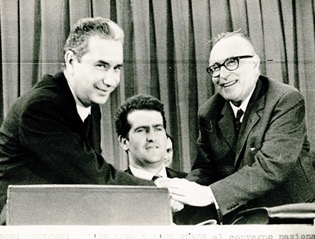
Gilberto Bonalumi, centre, between Aldo Moro and Giovanni Rumor in Bologna, March 1968, at the opening of the DC electoral campaign entrusted for the first time to the Youth Movement, of which the senator from Bergamo was then national secretary.
A few months later Moro wanted to see me alone in his private office. He thanked me for that rally that filled the Palazzo dello Sport in Bologna, and found original our little campaign pamphlet Pace, Protesta, Proposta (“Peace, Protest, Proposal”), written largely by L’Eco di Bergamo’s journalist Sandro Zambetti and splendidly laid out by that imaginative graphic designer who was Pic Cortesi. The conversation ended thus: “Dear Bonalumi, at a time not yet definable we shall have to prepare ourselves to hand over.” It is not that the absence of alternation did not weigh on the “difficult democracy” actually resolved within a bipolarism directly influenced by international events. In the crucial years of national solidarity, the ways out were two: that of a temporary collaboration between the major parties, DC and PCI, to prepare a competition on equal terms with the possibility of an alternative; and the other of a Mitterrandian type, to endow the entire left with competitive capacity. Neither of these two paths was seriously taken: and so came the crisis of the party system, which proved itself wholly unfit to undertake any self-reforming initiative. The terrorists believed the moment of the final push had come, forgetting too every word of Marx on the State (“it is not a harlequinade”, he had said) and on the toughness of political systems even when they appear frail.
Someone who had been present at the founding convention of the BR at Santa Margherita Ligure recounted how one of the leaders had expressed, more or less, the worry that they might even arrive too late, because the revolution would break out without them. The historical, political and social analysis carried out by the terrorists would deserve no consideration whatsoever, were it not that it was armed, dangerous and frontally directed against the democratic order — leaving victims in its wake, among them our own Guido Galli, a magistrate originally from the Upper Val Brembana.
Responding to the difficulties
To understand why even today no political models are on the field capable of responding to the difficulties and the voids of the new generations — so as to seize every useful opportunity to put back into order this time gone off its hinges. Freedom must be safeguarded, and hope must be organised.
It is impossible to speak of Aldo Moro and of the history of Italy without recalling his tragic end. His own particular capacity to hold together the essential elements of his political project: State and society, innovation and tradition, change and cohesion, political system and Christian Democratic party, in a social and political horizon sorely tested by the transition of the 1970s.
Being an alternative to himself does not confine him to his own party for the sake of its self-improvement, but projects him onto reform programmes, government alliances, the process of constitutionalising the political formulas from centrism to the centre-left, and to the “parallel convergences” that presuppose processes of social-democratisation of the left and the advent of a modern, republican right. Stepping out of the traditional dialectic of majority and opposition.
He knew how to move within the bipolar clash between the Cold War and détente.
What is to be done when victory is shared by two? And one is the strongest and most representative Communist Party in Europe — yet rooted in a period of the Resistance, of the post-war, of the Salerno turning point. The possibility of conducting foreign policy through internal policy did not prevent Moro from moving within the bipolar clash between the Cold War and détente, alarming the Western states to such an extent that, at the meeting of the industrialised countries in Puerto Rico, the German Chancellor Schmidt was used as a voice to make financial loans conditional on the alliances of the Italian parties.
For the State Department led by Kissinger, there were two “anomalies” that worried it in that still-prevailing phase of the Cold War: the Morotean action that kept alive the reasons for national solidarity, and Allende’s experience — coming to govern Chile with a left-wing alliance through an electoral process that respected democratic rules. The two moments were related, such were the ties between the political forces of the two countries despite different histories and geographies. Both failed with Moro’s death and with the coup d’état in Santiago.
He was a good, wise man and a friend. When he said to me: let us prepare to hand over.
On 13 May, in the Basilica of San Giovanni in Laterano, I too was present, before all the high offices of State, without the body of the deceased — already in the hands of the family by Moro’s explicit will. Marco Damilano notes a Craxi with arms folded and restless next to a Berlinguer carved in stone. The supporter of the negotiation and the standard-bearer of firmness, both defeated. At that time Rome looked like a dark city, the gloomy labyrinth in which the terrorists who had kidnapped Moro were hiding. In vain was Paul VI’s prayer to the God of life and death, who had not heard his request to free Aldo Moro — a good, gentle, wise, innocent man, and a friend.