
By Nick Cleveland-Stout* – Responsible Statecraft
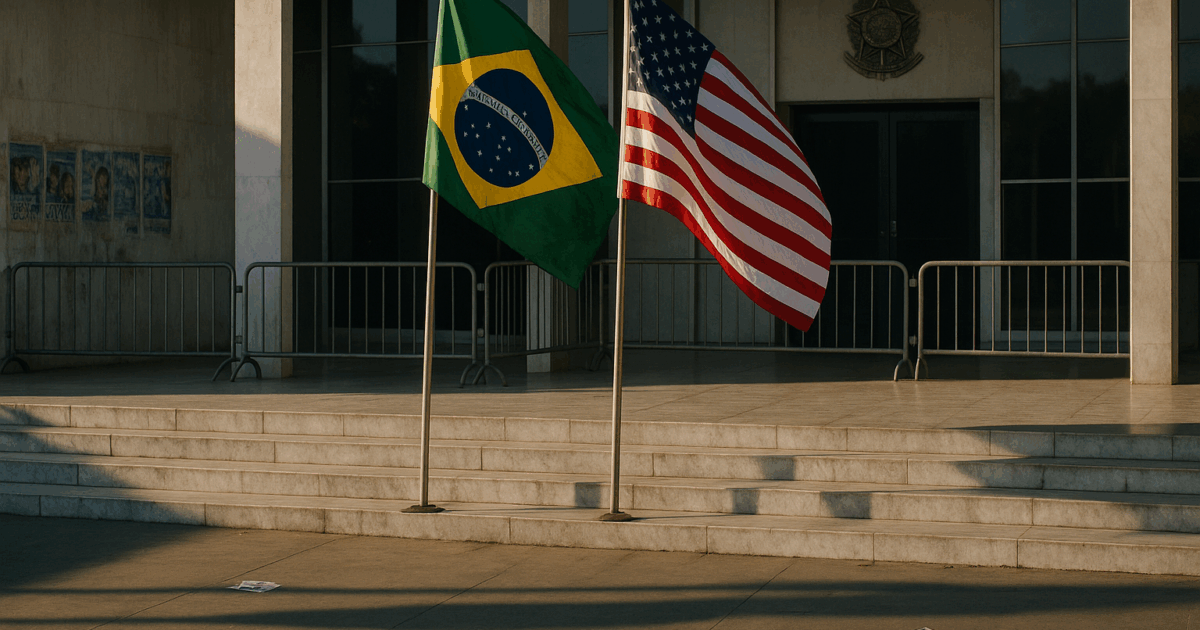
US interference in this weekend’s election in Brazil could help left-wing President Lula.
This Sunday, Brazilian voters head to the polls to decide whether leftwing incumbent President Luiz Inacio Lula da Silva will win a historic fourth term. Lula’s challenger is Flávio Bolsonaro, who has styled himself as a more moderate version of his father, former President Jair Bolsonaro, the rightwing firebrand who is serving a 27-year prison sentence for an attempted coup.
The tight electoral contest has been defined by the economy, crime, and scandal, as a probe into a prominent jailed banker revealed that he financed a new hagiographic biopic about the elder Bolsonaro at Flavio’s request.
If neither candidate receives more than 50% of the vote on Sunday, which is a near-certainty, the race will go to a runoff on October 25. According to an AtlasIntel/Bloomberg poll released on Tuesday, Bolsonaro would receive 47.7% of the votes in a potential runoff, compared to Lula’s 47.6%.
But in the final days of the campaign, one question looms large: what will the United States do?
Although Trump has not formally endorsed him, Bolsonaro is undoubtedly Washington’s preferred candidate. The administration has clashed with Lula’s government over trade, Cuba, and Venezuela, as well as a desire for access to Brazil’s rare earths supply.
Trump is also personally close to the Bolsonaros. Often at the request of the Bolsonaro family, the U.S. has engaged in a pressure campaign to weaken the Lula government, sparking fears of further interference.
Washington’s pressure campaign
Trump’s interference in Brazilian politics started in earnest last summer. Flávio’s brother Eduardo persuaded the Trump administration to impose 50% tariffs on Brazilian imports and sanctions on a Brazilian Supreme Court judge in an attempt to get Brazilian authorities to drop Jair’s trial, which Trump called a “witch-hunt.” White House Press Secretary Karoline Leavitt even indicated the U.S. could use “military might” against Brazil over his prosecution.
Those sanctions and tariffs were later rolled back, though in July the U.S. placed new tariffs totalling 37.5% on Brazilian imports. This time, the U.S. cited unfair trade practices and singled out “Pix,” a popular payment transfer system that has drawn the ire of U.S. credit card companies like Visa and Mastercard, which miss out on transaction fees.
In May, the State Department also classified two Brazilian crime groups — Comanda Vermelha (CV) and Primeiro Comando da Capital (PCC) — as terrorist organizations, partially under the justification of combatting “narcoterrorism” in the region. Flávio himself visited the Oval Office to persuade Trump to classify the PCC and CV as terrorist organizations. “We’ve got to help these guys,” Trump told aides at the time.
The move alarmed many observers because Trump has frequently invoked the threat of “narcoterrorism” to justify a campaign of lethal air strikes on alleged drug smuggling boats and the kidnapping of Venezuelan President Nicolas Maduro.
James Green, Professor Emeritus of Portuguese and Brazilian Studies at Brown University, told RS these U.S. moves were met with apprehension in Brazil because they indicated that Trump’s threats were not just bluster. “Brazil did not want the U.S.’ imposition of this category on these criminal organizations because it opened the door for many ways in which the Trump administration could interfere in Brazilian internal politics,” said Green.
“Even though they haven’t overtly said, ‘Oh, Flávio is my candidate,’ they sent all these signals to indicate that that’s who the United States wants to see elected,” added Green.
Gunther Rudzit, assistant professor International Relations at ESPM, a private university in São Paulo, explained that, while not all of these actions are explicitly tied to a plan to boost Bolsonaro’s candidacy, the cumulative pattern is “an attempt to shape the political environment in which the Brazilian election is taking place.”
In the event that Lula does win, the question will be whether Washington will recognize the victory. In a press conference outside the State Department in September, Eduardo Bolsonaro suggested the U.S. “could perfectly well refuse to recognize the Brazilian elections.”
If the U.S. takes that approach, Trump could draw support from newfound allies in the region. Right-wing parties are experiencing a resurgence in Latin America, winning in Argentina, Chile, Ecuador, Peru, and Bolivia. Trump openly endorsed candidates in Colombia and Honduras who won their respective elections. “We have numerous people, Argentina, lots of people that I got elected,” Trump said last month.
Brazil’s response has been swift. Abin, the Brazilian intelligence agency, sent a report to key government agencies in August sounding the alarm about potential U.S. interference in the election. Brazilian officials also denied requests for visas of two State Department officials, claiming the purpose of their visit was to discredit the integrity of Brazil’s electoral system.
The US has taken other actions to place pressure on the Lula government. In July, the São Paulo Consulate took the unusual step of inviting conservative social media influencers for a roundtable to discuss “freedom of expression and the digital environment.” The Guardian reported on Thursday that the State Department also has plans to award $1 million to groups in Brazil that oppose “judicial overreach and censorship by Brazil’s supreme court,” a reference to Washington’s sanctioning of Brazil’s judge, Alexandre de Morães.
Lula’s Worker’s Party has also requested that the Supreme Court investigate potential interference in the campaign by Rockbridge, a secretive political advocacy group backed by Silicon Valley investors like Peter Thiel. People close to Bolsonaro pitched plans to secure investment promises from Rockbridge and even form a “Technology Council” made up of people like Palantir’s Shyam Sankar and Joe Lonsdale to advise the candidate. A spokesperson for Rockbridge told the Intercept Brasil that none of these plans materialized.
Will Trump’s gambit backfire?
It is far from clear that the U.S. pressure campaign will help Bolsonaro since many Brazilians may view the attacks as an affront to national sovereignty and economic independence, causes that Lula has championed since his days as a labor union leader in the 1970s and 80s. After the Trump administration imposed tariffs on Brazil last July, the Lula administration’s approval ratings jumped above 50%, up from 47% the month prior.
Camila Feix Vidal, professor of international relations at the Federal University of Santa Catarina, told RS the “U.S. actions towards Brazil — particularly the tariffs, interest in rare earth reserves, and the criticisms of Pix — all fostered a nationalist spirit in Brazil, at least initially.”
Lula has even made Washington’s tactics a central focus of his campaign. A new ad for the Lula campaign, set to air Friday, says “Flávio Bolsonaro is Trump’s candidate and what Trump wants is to colonize Brazil, take our riches, steal our future and leave us in the dust.” In an interview this week, Lula said “I told Trump: ‘Don’t interfere in the Brazilian elections because otherwise you’ll lose the elections.’”
Rudzit of ESPM noted that Flávio Bolsonaro has even had to call for the suspension of U.S. tariffs for fear of nationalist backlash. “The closer the association between external pressure and the Bolsonaro family, the easier it is for Lula to present himself not simply as the incumbent defending his administration, but as the president defending national autonomy,” said Rudzit.
Rudzit added that while economic pressure could help Lula in the short term by generating nationalist resistance, the economic costs might ultimately weaken his chances at the ballot box. “Much depends on who Brazilian voters ultimately blame for those costs: Washington, the Bolsonaro family, Lula’s government, or some combination of them,” said Rudzit.
Even if Bolsonaro does win, Trump may find an ally constrained by competing national interests and domestic political pressures. Quincy Institute non-resident fellows Andre Pagliarini and Feliciano de Sá Guimarães argued in a recent policy brief that there is reason to believe that a Bolsonaro presidency may still not be as subservient to U.S. demands as Trump would like, particularly on China.
“A Brazilian government visibly inclined toward the United States would face its own constraints,” Pagliarini and Guimarães wrote. “Flavio Bolsonaro’s father discovered as much during his presidency, when an initially hostile posture toward Beijing gave way to the practical demands of governing a country whose economic relationship with China could not simply be subordinated to ideological posturing.”
Whoever wins, the margins are expected to be slim, creating conditions for a contested election.
*Research Associate in the Democratizing Foreign Policy program at the Quincy Institute. Previously, Nick conducted research on U.S.-Brazil relations as a 2023 Fulbright fellow at the Federal University of Santa Catarina.