
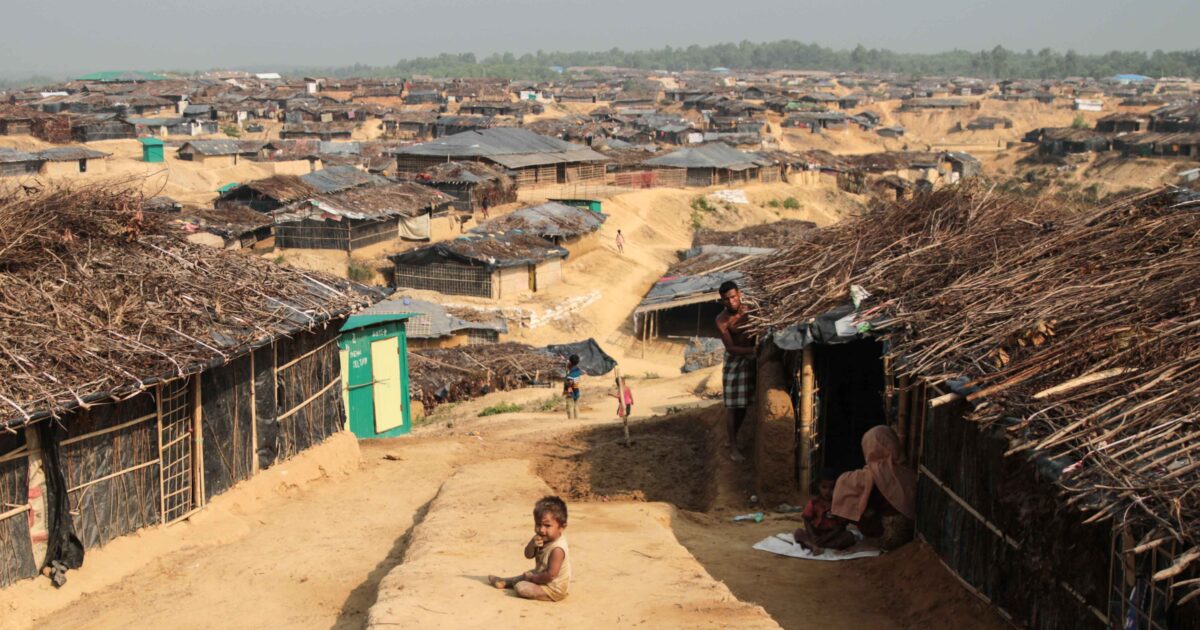
Imagen: Campo de refugiados Kutupalong en Cox’s Bazar, Bangladesh
By Kaamil Ahmed* and Oliver Holmes** – The Guardian
Judgment finds ‘intent to destroy a substantial part of the Rohingya population’ after case seen as critical test for dealing with most serious of state crimes.
Myanmar committed genocide against its Rohingya minority during a 2017 military campaign, the world’s highest court has ruled, in a historic and unprecedented decision.
The judgment from the international court of justice (ICJ) – which has never previously found a state responsible for genocide – ends a seven-year legal battle that was seen as a critical global test for dealing with the most serious of all state crimes.
The ICJ president, Yuji Iwasawa, said a majority of nine judges on the 15-seat court found that “the Republic of the Union of Myanmar has committed genocide against the Rohingya”.
The 2016-17 campaign by Myanmar’s military forced more than 700,000 mostly Muslim Rohingya to flee across the border into Bangladesh, arriving with reports of mass killings of adults and children, gang-rapes and burned-down villages.
Nearly a decade later, in a refugee camp in Bangladesh, crowds of Rohingya people watching on outdoor TV screens leaped up in celebration and applause as the final verdict was read out.
One Rohingya survivor, Yousuf Ali, had travelled to the court to hear the verdict. “Today, we have finally been heard, and it is a profound relief,” he said. “This judgment gives hope to our children and the next generation of Rohingya. But our fight is not over.”
Governments had been anxiously awaiting the decision handed down in the Netherlands, where the UN-run court is based, in part because the ruling will set a precedent for genocide claims, notably a high-profile case against Israel.
In what could become a crucial factor for the Gaza case, where Israel claims its mass killings are part of a counter-terrorism operation, judges dismissed Myanmar’s claims of carrying out legitimate military operations against insurgents.
Genocide, defined after the Nazi Holocaust by a 1948 UN convention, is harder to prove than war crimes because it requires evidence of specific “intent” to destroy a national, ethnic, racial or religious group. Iwasawa said during the reading of the decision that the court was “fully convinced that Myanmar committed acts falling under … the genocide convention with an intent to destroy a substantial part of the Rohingya population in Myanmar”.
After the ruling, Britain’s foreign minister, Ed Miliband, said the government was expelling Myanmar’s defence attaché and called “urgently” for a session at the UN security council, the body that has the power to enforce ICJ rulings.
The case was raised by the Gambia, a Muslim-majority state, on behalf of Myanmar survivors. It rested on claims of genocidal statements and “patterns of conduct” that showed attempts to destroy the group during assaults on Rakhine state, including gunning down people as they fled and blocking their return.
In January, the ICJ held closed-door sessions to hear from survivors who had travelled from camps in Bangladesh. More than a million Rohingya still live there, in the world’s largest refugee settlement, and fewer than 600,000 are estimated to remain in Buddhist-majority Myanmar.
Refugees who had fled to Bangladesh told the Guardian in 2017 of a massacre in the village of Tula Toli, where survivors described systematic shooting of civilians, mass graves and the drowning of children in a river. That village, which satellite footage later showed had been burned down, was one of several analysed by rights investigators and built a case for genocide.
During hearings, the Gambian justice minister, Dawda Jallow, told the court the case was not “about esoteric issues of international law”. “It is about real people, real stories and a real group of human beings,” said Jallow. “The Rohingya of Myanmar. They have been targeted for destruction.”
Legal experts see Thursday’s judgment as a key test for sexual violence in genocide assessments, as the convention says the crime can include acts with the intent to “prevent births”. Investigators have said gang-rapes and soldiers’ mutilation of women’s genitals were carried out intentionally and systematically to stop reproduction.
The court appeared to back that assessment, accusing the military of using sexual violence to “physically and mentally impair the willingness and ability of the [Rohingya] population to procreate”, referring to cultural stigma for rape survivors. Myanmar had also imposed other measures to restrict births, the court ruled, such as limits of two children per Rohingya family.
Myanmar has denied carrying out a genocide, claiming its actions targeted a Rohingya militant group that conducted guerrilla-style attacks. Its military responded with massive “clearance operations”.
However, judges rejected Myanmar’s claim that its actions were primarily intended as counter-terrorism operations, or even that they were an attempt to punish or forcibly displace the population but without committing genocide.
The country’s leader, Min Aung Hlaing, who headed the military during the 2016-17 attacks, has a pending arrest warrant from the international criminal court (ICC), which, unlike the ICJ, prosecutes individuals and not states, on allegations of crimes against humanity.
The former general overthrew the elected government of Aung San Suu Kyi in a 2021 coup, triggering a civil war that has left tens of thousands dead. He was installed as civilian president in April after elections that were widely discredited.
While the ICJ does not have the power to enforce rulings, its decisions are considered binding, carry diplomatic weight and can shape international action, including sanctions.
During a reading of the decision that lasted more than two hours in a packed Great Hall of Justice in The Hague, Iwasawa called for Myanmar to provide reparations and restitution. This included allowing the safe return of Rohingya to their homes, returning or replacing their property, and providing physical and mental rehabilitation.
The ruling was also significant as it formally classified the Rohingya as a distinct ethnic group under international law, something they have been denied by Myanmar, which refers to them as Bengalis or foreign migrants.
Reached by phone shortly after he left the courtroom, the lead counsel for the case against Myanmar told the Guardian the mood had been emotional in the room as the judgment was read out in front of his legal team, which included Rohingya.
“This is the ICJ recognising their history of discrimination, recognising them as a group, recognising the horrific violence they endured and suffered,” said Arsalan Suleman. “It was a really emotional moment for them and the whole team. We felt the weight of the court’s judgment.”
Israel and its chief ally, the US, have been closely following the Myanmar case, as the decision provides the strongest hint of how judges could assess the Gaza case, brought by South Africa. UN independent investigations, as well as genocide scholars, have already said Israel has committed acts of genocide in Gaza.
A judgment finding Myanmar had breached the convention has been predicted to lead to the US imposing sanctions on ICJ judges, including this year’s Nobel peace prize winner, Navi Pillay.
Washington had considered the Rohingya crisis to be a genocide, based on a decision by the Biden administration. However, the Trump administration has been on the offensive against international rights bodies, including imposing sanctions on the ICC.
Two other ICJ cases dealing with atrocities in the 1990s Balkan wars fell short of finding states directly responsible for genocide, although Serbia was found legally responsible for failing to prevent or punish genocide committed by Bosnian Serb troops at the Srebrenica massacre.
Other UN tribunals have established genocide in only a handful of cases since the Holocaust, including Cambodia’s Khmer Rouge rule in the 1970s and the 1994 mass killings in Rwanda.
*Guardian journalist, covering international development.
**Guardian journalist. He was previously Jerusalem correspondent and has reported across the Middle East and Asia.